In this guide
An early-career program can be interesting even when its current application window is closed. The challenge is to learn from the available information without turning a past announcement into a promise about the next cycle. A dated program brief helps you separate what is known now from what you can prepare independently.
On October 2, 2026, the City’s Summer Internship Program page marked the 2026 application cycle closed. The Innovation and Technology summer program page also marked its 2026 applications closed. These observations do not establish future opening dates, future eligibility, or the availability of a particular role. Recheck the named program’s official announcement before planning a submission.
Identify the exact program
Write its full name, sponsoring team, cycle year, and official page. Internships and fellowships with similar themes may have different eligibility language, project expectations, and application materials. A description elsewhere on the website can introduce the team without replacing the actual program notice. Avoid combining requirements from several programs into a single imagined application.
Use a separate brief for each serious option. Include a short reason you are interested in the work, not just the program label. A hypothetical candidate could be drawn to service design because they want to learn how public instructions are tested. Another could prefer a project that involves organizing information. Those interests help guide research but do not determine eligibility.
Read the work before the promotional summary
Look for the activities participants are expected to perform and the outputs they might help create. Then ask what preparation those activities would require. You are trying to understand the learning environment, not assume that every participant receives the same project or that participation leads to a permanent position.
The technology program page describes teams and project-oriented work, but future assignments must be confirmed in the relevant announcement. In your brief, distinguish a program-wide theme from an actual role description. This prevents an appealing example from becoming a certainty in your planning or a claim that the program has already matched you to a team.
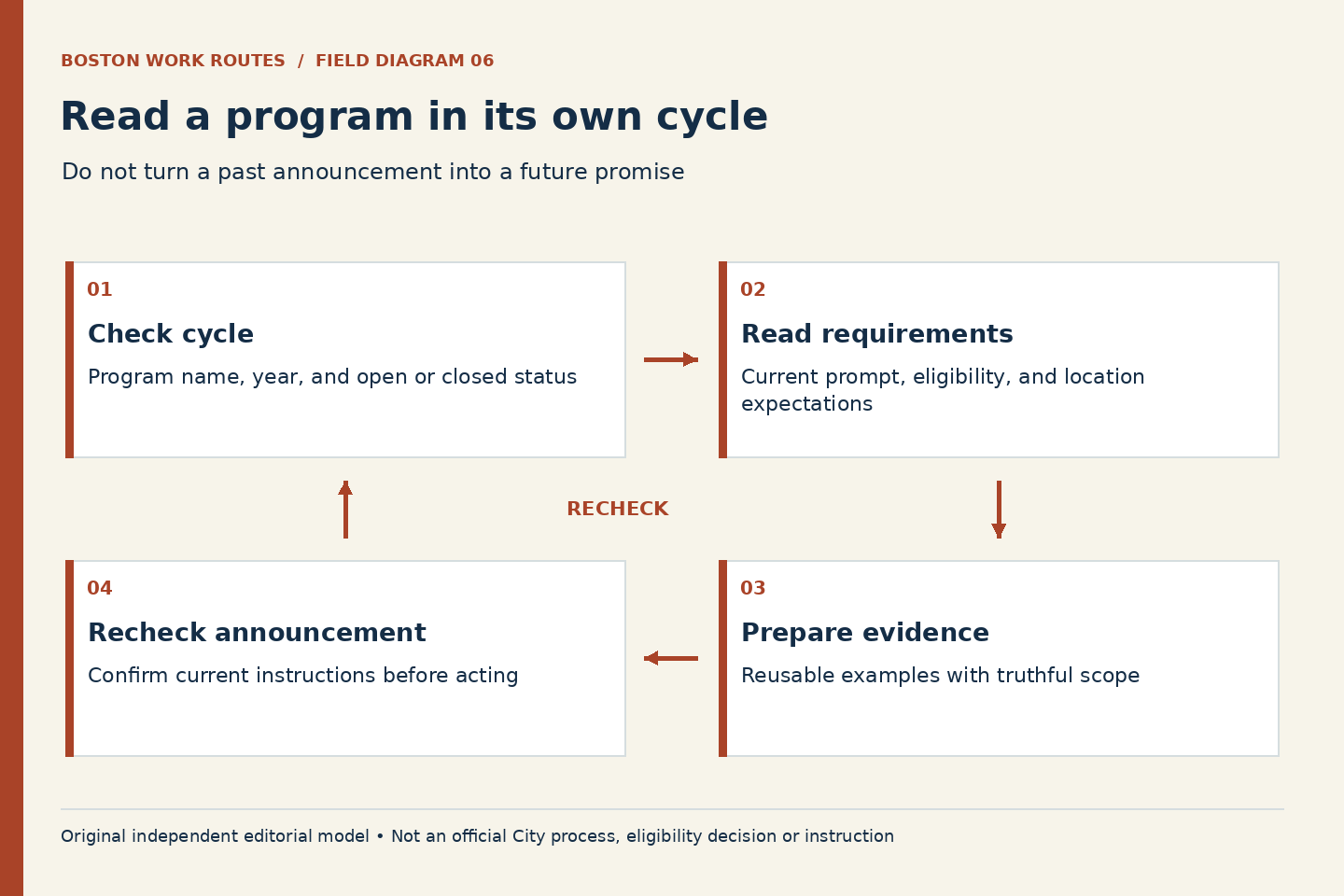
Make a cycle-specific checklist
- Status: open, closed, or not yet announced, with the date you checked
- Eligibility: the current wording, including any education or experience conditions
- Work: project themes and any named role description
- Practical expectations: location, schedule, duration, and questions still unanswered
- Materials: the prompt and documents requested for that cycle
- Destination: the official application link reached from the program page
Do not copy an old closing date into a future calendar entry as though it were confirmed. If you want a reminder to research later, label it as your own check-in rather than an application deadline. A deadline should come from a current announcement and retain its stated time zone where one is supplied.
Prepare reusable evidence while waiting
You can build a truthful project inventory, improve a resume, and practice explaining why a particular task interests you. Keep any sample work clearly labeled as study or independent practice. The application evidence workbook helps you connect examples to actual criteria when a new prompt appears, without inventing a response to a prompt that has not been published.
Choose one bounded learning exercise instead of collecting courses indefinitely. The municipal learning plan offers a way to define an artifact, check it, and describe its limits. Preparation should leave you with a clearer understanding and an honest example, even if the next cycle changes or a different opportunity becomes a better fit. When applications reopen, reread the complete notice rather than relying on your older brief.
Related reading: Build an Application Evidence Workbook That Stays Honest, Build a Six-Week Municipal Career Learning Plan.