In this guide
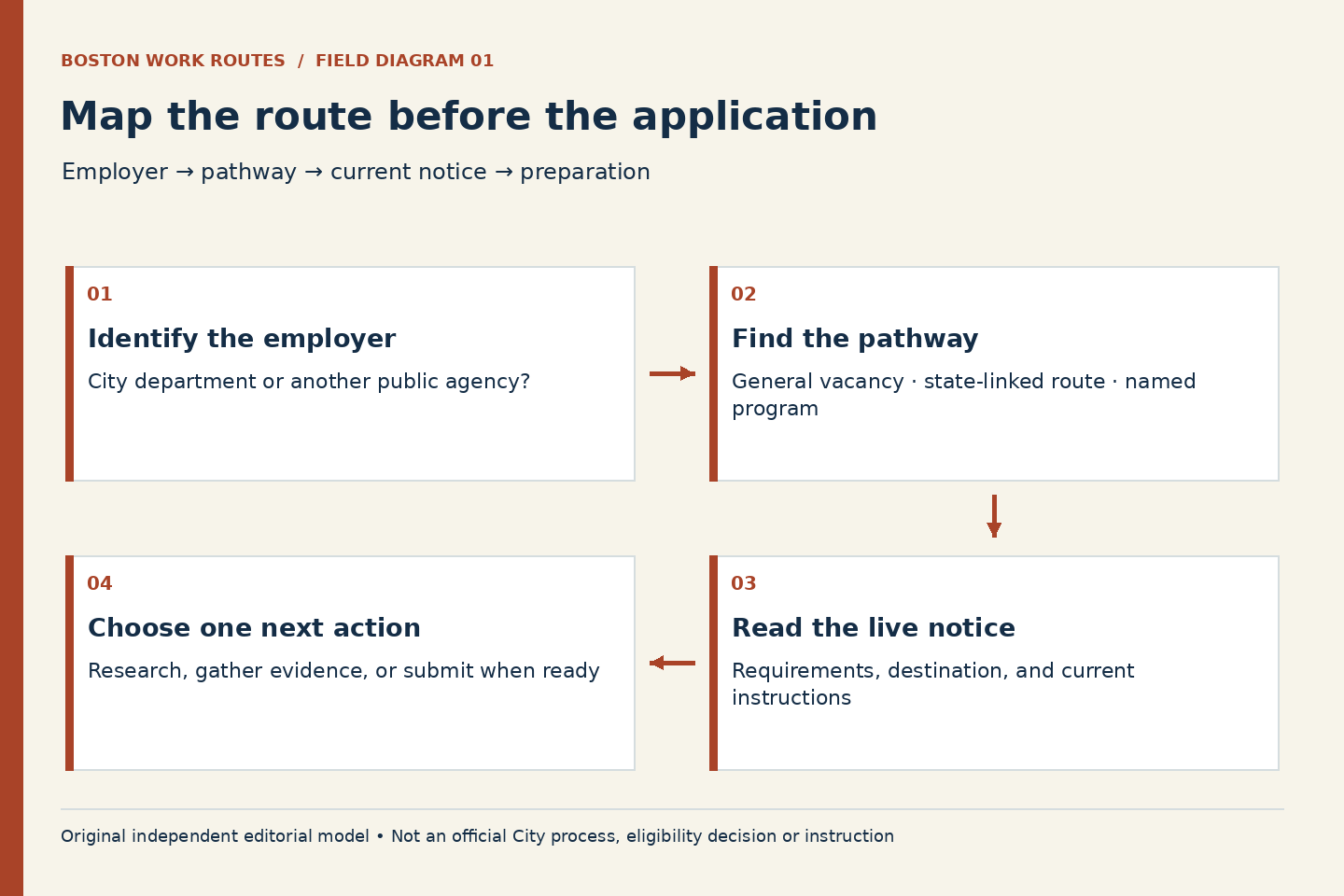
A municipal career search becomes easier when it begins with a route rather than a job title. Two positions can serve the same neighborhood and still belong to different employers, use different application processes, and ask for different evidence. Your first useful deliverable is a short map: who employs the role, how candidates enter that process, what the work involves, and which fact you need to confirm next.
This guide offers an independent planning method. It is not a list of live openings or a prediction about selection. On October 2, 2026, the City’s Career Center organized general job search, specialized pathways, early-career programs, and links to other Boston public agencies. Use that official starting point to verify the route before relying on a saved advertisement or an older tutorial.
Start with the employer, not the location
A job performed in Boston is not automatically a City of Boston position. Write the employer’s full name from the posting, then record the department or program separately. A public agency, contractor, community organization, and City department may collaborate on the same issue without sharing a hiring system. The organization that published an article about a project may also be different from the organization recruiting for a particular role.
Create three fields in your notes: employer, operating team, and official posting URL. If one is unclear, mark it as unresolved. This small distinction keeps later research organized. It also helps you direct a precise question to the right contact instead of sending personal materials to whichever office appears first in a search result. Our department research guide provides a deeper method for following these connections.
Identify the entry route
Treat a general vacancy, a named internship or fellowship, and a state-linked hiring route as separate research projects. Boston’s civil and labor service overview describes state-first steps for specified official-service and labor-service roles. That is a reason to inspect the exact pathway, not to assume every municipal role has an examination or a common waiting list.
For each opportunity, answer four questions in ordinary language. Where does the current announcement say to begin? Is there an initial registration, examination, or program application? Does a later opening require another response? What official notice will tell you the next step? If the answer is unknown, your immediate task is to find it. Creating another account does not resolve a route you have not identified.
Look past recognizable titles
Build your search around work you can describe. You might be interested in explaining a service, maintaining an asset, checking records, analyzing information, coordinating a project, or organizing an event. These are task families rather than official job classifications. A single role can combine several of them, and the same task can appear under unfamiliar titles in different departments.
For a hypothetical example, someone who enjoyed organizing a volunteer event might initially search only for event jobs. Their actual evidence could include scheduling, accessible instructions, record accuracy, and coordinating handoffs. Those examples may be relevant to several kinds of work, but they do not prove that the person meets any vacancy’s minimum requirements. The useful next move is to compare the duties of actual postings.
Make a two-lane shortlist
Keep one lane for opportunities worth reviewing now and another for directions worth learning about. A current application needs a real posting, enough understanding of its requirements, and a feasible way to complete the requested materials. A learning direction can be broader: a task you want to practice, a credential you need to investigate, or a department whose work you want to understand.
This prevents every interesting role from becoming an urgent application. Limit the active lane to a number you can review carefully. For each entry, record one reason the work interests you and one reason your evidence may fit. If you cannot write either reason without repeating the job title, return to the description before drafting a cover letter.
Use evidence as a routing signal
An evidence gap is information. It may mean you need a clearer example from existing work, a better understanding of a requirement, or a longer preparation path. Separate these possibilities. Improving a description of something you already did is different from gaining a qualification you do not hold. A practice project can support learning, but it should never be relabeled as employment or a professional credential.
Start with the application evidence workbook and choose three criteria from one posting. Link each to a specific experience, or mark it unanswered. Avoid invented compatibility percentages. A neat score can hide an important missing requirement, while a short written explanation shows exactly what still needs attention.
Keep a route card you can update
- Employer and team: copied from the current official posting
- Work focus: two or three recurring activities in your own words
- Pathway: the application route the official source actually identifies
- Evidence: one relevant example and one gap to investigate
- Conditions: the stated schedule, location, term, and unresolved questions
- Next action: one concrete step and the source needed to complete it
Add the date you checked the source, because an accurate route card can become stale. Preserve a private copy of the posting when appropriate, but reopen the live version before acting. If a link moves or a program closes, revise the card instead of treating the change as a failure of your whole career plan. The map is working when it helps you choose a better next action with fewer assumptions.
Related reading: Build a One-Page Brief on a Boston Department, Build an Application Evidence Workbook That Stays Honest.