In this guide
The hardest part of an application is often deciding what counts as evidence. A list of responsibilities says what a role involved, but it may not show how you handled the work. An evidence workbook bridges that gap. It connects a requirement from a posting to a specific experience, your personal contribution, a supportable result, and any important limits.
This is an editorial preparation method, not a City form or a screening formula. The City’s Human Resources page, checked October 2, 2026, describes recruitment across departments and job classification tied to duties and qualifications. Your workbook should therefore begin with the actual role you are considering. Keep it privately on your device; do not put sensitive records into a public worksheet or this publication’s interactive tools.
Begin with three criteria, not your whole history
Choose three substantive criteria from the current posting. They might concern explaining information, maintaining accurate records, coordinating people, or using a particular skill. Copy only the short wording needed for your private reference and link to the source. If a criterion is unclear, mark it for clarification rather than translating it into a requirement you find easier to satisfy.
For each criterion, ask when you have actually done related work. Paid work is one possible source, but a project, volunteer responsibility, or course assignment can also supply an example when described accurately. Keep the setting attached to the experience. The same action can have different scope, supervision, and consequences in different settings, and your reader should not have to guess which applies.
Give each example a stable structure
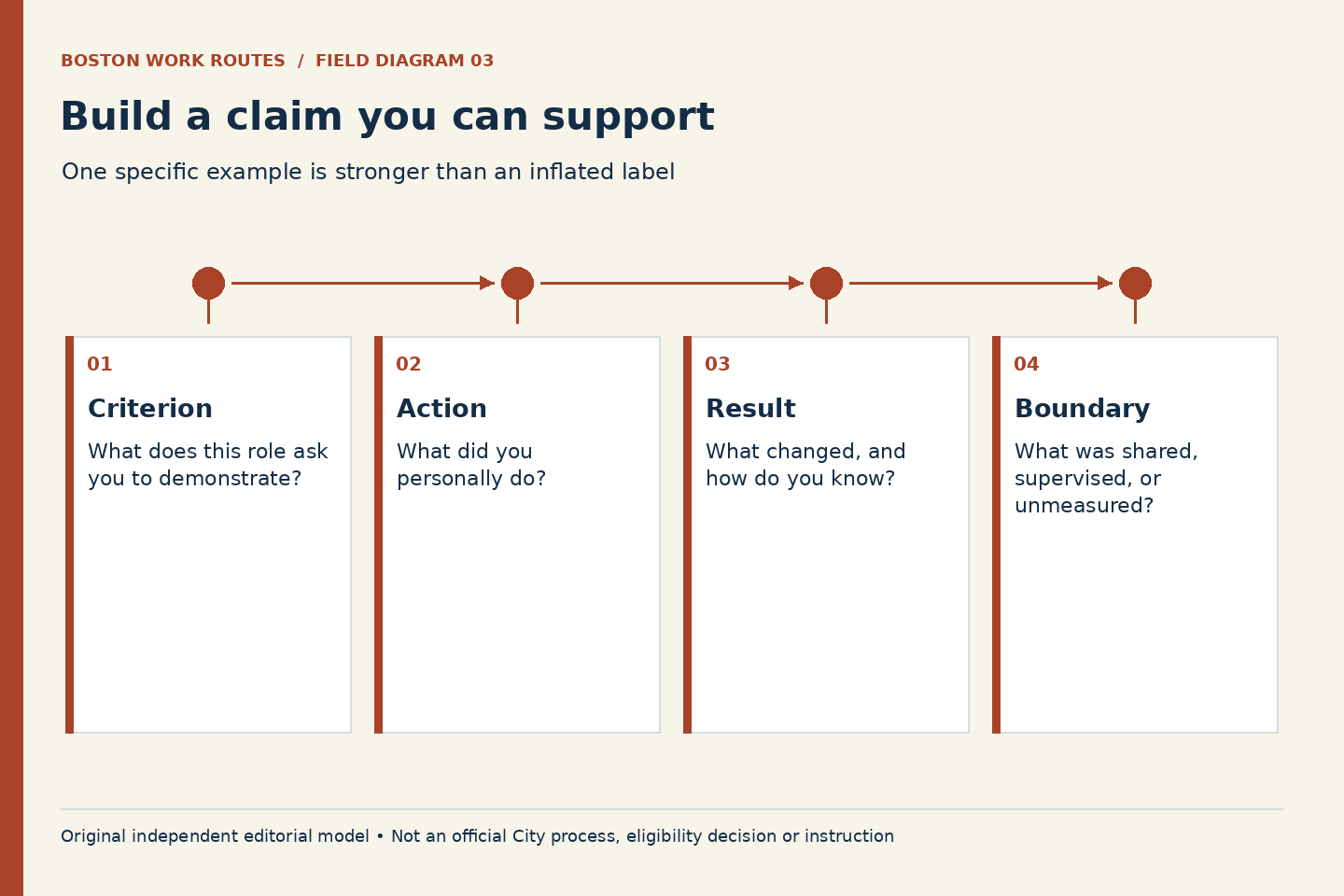
Use six fields: criterion, context, action, result, verification, and boundary. Context explains the situation briefly. Action describes what you personally did. Result states what happened without claiming more certainty than you have. Verification is a private reminder of how you know. Boundary records what you did not own, what someone else approved, or what you could not measure.
The boundary field is especially useful. It prevents a team outcome from becoming a claim of sole ownership during repeated editing. If you drafted instructions that a supervisor reviewed, write that down. If you helped organize a process but did not design its policy, keep the distinction. Accuracy is not a weakness to edit away; it is what makes an example credible when someone asks follow-up questions.
Work through one hypothetical row
Imagine a volunteer project where participants repeatedly asked which entrance to use for an event. A hypothetical evidence row might say: the team needed clearer arrival instructions; you reviewed the existing message, identified the missing entrance description, drafted a revised version, and asked the organizer to verify it. The organizer then approved the change and used it in the next message.
The supportable result is that a verified instruction was adopted. Unless the team measured later questions, do not add a percentage reduction or claim that confusion disappeared. The boundary is that you were a volunteer contributor and the organizer retained approval. This modest example can still demonstrate careful communication and verification. It is more informative than a dramatic result built from an invented number.
Distinguish records from material you can share
A private verification note might refer to a dated project folder, an approved public report, or a certificate you hold. It does not mean you should attach the underlying material. Workplace documents may contain confidential information, and even an apparently harmless screenshot can reveal names, internal systems, or someone else’s data. Use a short description unless sharing is explicitly appropriate and permitted.
For a portfolio, build a sanitized illustration or a clearly labeled practice sample with fictional data. Do not alter a confidential document and assume removing a name makes it safe. The technical portfolio guide explains how to show method without presenting private operational information. Where the employer requires official evidence, use its designated process rather than improvising a public link.
Let the workbook improve your drafting
Once the rows are sound, choose the strongest relevant examples for the application. A resume bullet usually needs a compact action and useful context. A longer response may need the decision you faced, the steps you took, and the result. An interview story can include what you would improve. These are different presentations of the same underlying facts, so keep the workbook as the source of consistency.
Use the resume bullet workshop to tighten language after the facts are settled. Editing should remove repetition and clarify scope, not introduce new accomplishments. If a draft suddenly includes a metric, tool, or responsibility missing from the workbook, stop and verify it. A polished sentence is not evidence merely because it sounds plausible.
Review gaps without disguising them
An empty row has several possible meanings. You may have forgotten a relevant example. You may understand the work but lack a recent demonstration. You may not yet have the required qualification. These situations call for different next steps: reviewing past projects, making a bounded learning sample, or researching a formal preparation route. Do not treat them as one generic confidence problem.
- Can another reader understand your personal contribution?
- Is every number supported by a record or clearly labeled as an estimate where appropriate?
- Are study, volunteering, practice, and employment described distinctly?
- Have shared outcomes retained their shared ownership?
- Are private or third-party details absent from materials you plan to send?
- Can you explain the example aloud without adding facts to make it work?
Keep a version for each application, with the posting date and the criteria you selected. Reuse truthful examples when they fit, but reconsider the emphasis for each role. The workbook is complete enough when it supports a clear, accurate application and reveals the questions still open. It does not need to become a permanent archive of every task you have ever performed.
Related reading: Build a Technical Portfolio Without Exposing Private Work, Write Municipal Resume Bullets That Show the Work.