In this guide
Public service can be a meaningful direction without pointing to one obvious job. You may care about a neighborhood issue, enjoy a certain kind of task, or want work whose results people can use. Those motivations are a starting point. To choose a role direction, translate them into recurring activities, operating conditions, and evidence of the contribution you can make.
The goal is a researchable shortlist, not a verdict about your ideal career. A title, department mission, or impressive project can attract attention while revealing little about an ordinary workday. This guide helps you examine that gap. It is an independent decision method, and any hypothetical examples below illustrate a process rather than describe actual vacancies or promise a route into employment.
Name the service contribution
Ask what you want to help become more accurate, accessible, reliable, understandable, or well coordinated. These words are useful because they connect purpose to work. Wanting to help residents might lead you toward direct communication, but it could also mean maintaining records, testing a digital form, organizing supplies, or ensuring a project team receives correct information at the right time.
Write a sentence that begins with a concrete action. For example, a hypothetical direction could be helping people understand a complicated process through clear instructions. Another could be keeping shared information accurate so others can act on it. Neither sentence is an official occupation. Each gives you a lens for reading postings without narrowing your search to a familiar title too soon.
Study the recurring tasks
Collect two or three current descriptions that seem relevant and highlight the activities repeated across them. Separate tasks you enjoy doing from subjects you merely enjoy reading about. Interest in transportation does not automatically mean you want to manage a schedule, analyze a dataset, maintain equipment, or respond to service questions. These are different kinds of daily work within a broad public purpose.
For each activity, make a three-part note: energy, evidence, and learning. Energy asks whether you would willingly do the task repeatedly. Evidence asks what you have already done that is relevant. Learning asks what you still need to understand. Avoid turning these into a single score. Strong interest cannot replace a required credential, and good evidence does not guarantee you would enjoy the conditions of the role.
Understand the organization around the job
The Boston department directory, checked October 2, 2026, provides official routes into departmental information. Use it to identify the team connected to a posting, then read the actual service pages and project descriptions. Look for the people who use the service, the outputs the team produces, and the other groups it coordinates with. Do not infer a vacancy from a department’s existence.
A practical research note contains one service example, one recurring operational need, and one question about the role’s contribution. This is more useful than memorizing a mission statement. It can help you explain why the work interests you without claiming insider knowledge. The department research method expands this into a short, source-linked briefing.
Examine conditions before idealizing the mission
A role’s purpose and conditions both matter. Read what the posting says about location, schedule, employment term, travel, physical tasks, and other practical expectations. Keep your own constraints private, but use them honestly in your decision. If a condition would make the role unworkable, clarify it before investing heavily in an application or assuming an arrangement can be changed later.
Distinguish a hard constraint from a preference. A preference might make one role more attractive; a constraint may require a definite answer. Do not assign missing information a favorable value. Write unknown and identify where a reliable answer could come from. A decision can remain provisional while you learn more, especially when an advertisement does not describe the working pattern in enough detail.
Test a direction with a small practice task
Choose a low-risk exercise that resembles one element of the work without impersonating the employer. You might rewrite a fictional service instruction, organize an invented project schedule, or check a public dataset’s documentation. Keep the exercise small enough to finish and label it as practice. Do not contact residents, handle real cases, or collect personal information to make a sample look more realistic.
Afterward, ask what felt satisfying, what required care, and what you underestimated. Perhaps you enjoyed writing but found source checking harder than expected. Perhaps the interesting part of a data exercise was defining the question rather than making the chart. These observations can refine your search. The learning-plan guide turns them into a bounded sequence rather than an endless list of courses.
Build a shortlist with reasons
- Role direction: describe the recurring work, then add relevant titles
- Service connection: identify who benefits from that work
- Existing evidence: name a specific example with accurate scope
- Entry questions: record requirements you still need to verify
- Conditions: separate confirmed facts from material unknowns
- Next experiment: choose one research or learning action
Keep at least one sentence explaining why each direction belongs on the list. Remove directions that depend entirely on imagined working conditions or a title’s prestige. The City’s Career Center is the appropriate official starting point for checking current opportunities; this shortlist does not tell you which roles are open or whether you qualify.
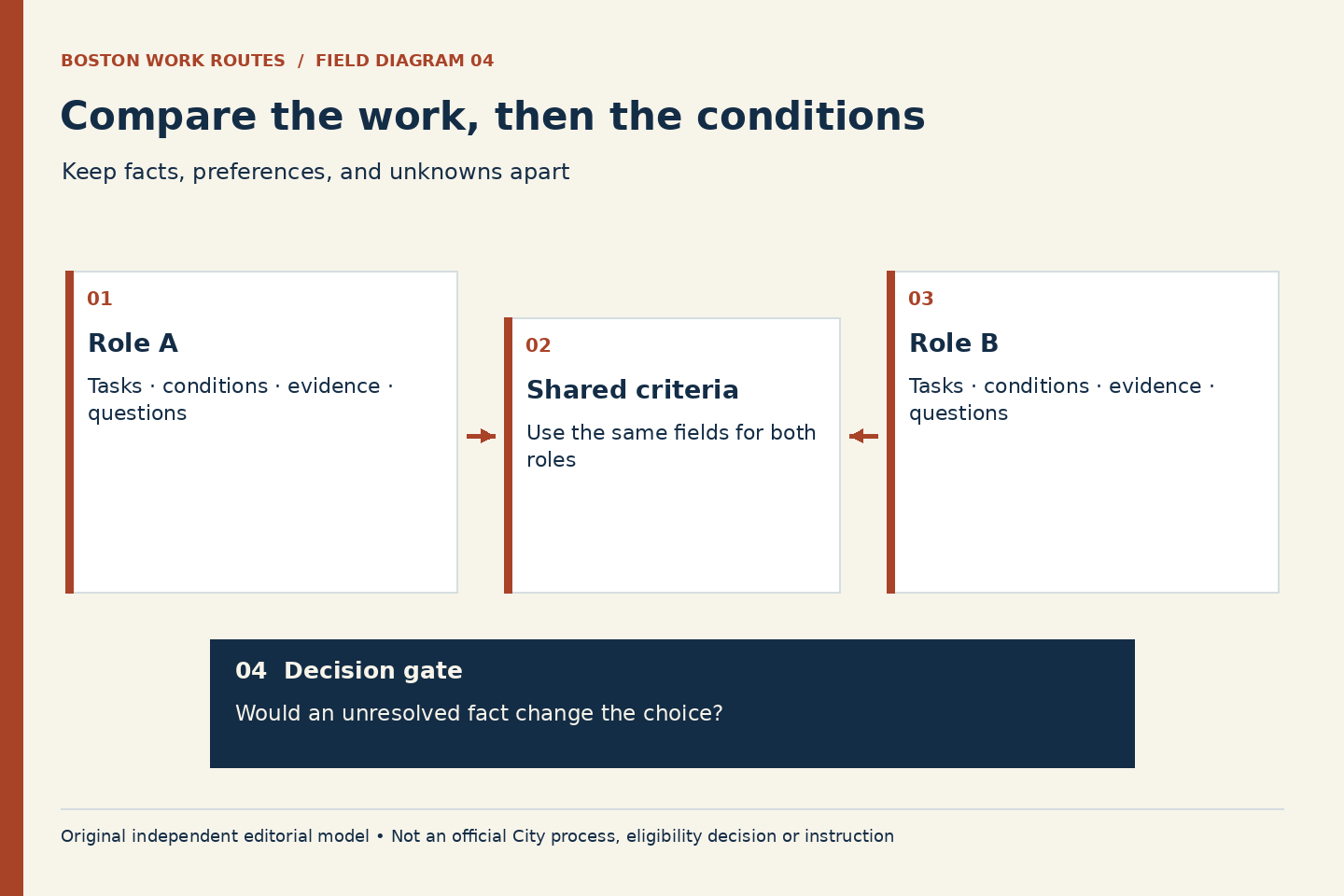
When two real opportunities remain, use the two-role comparison worksheet and apply the same fields to both. You do not need to resolve your whole professional future before taking one sound next step. A useful choice is one supported by current information, truthful evidence, and a clear understanding of what you still need to ask.
Related reading: Build a One-Page Brief on a Boston Department, Build a Six-Week Municipal Career Learning Plan, Compare Two Municipal Roles Without Inventing a Winner.